-
Shop
- Advanced Technologies
- AI Skills
- AI Skills Mastery 2026 Collection
- Bathroom
- Best-Sellers
- Car Accessories
- Confidence
- Dating & Social Skills
- Digital Resources
- AI & Technology
- Beauty
- Budgeting & Saving
- Car Buying & Ownership
- Electronics & Technology
- Entrepreneurship & Business Growth
- Financial Independence
- Financial Mindset & Psychology
- Goal Setting
- Home Styling & Organization
- Kitchen & Recipes
- Leadership
- Mindset
- Online Business
- Parenting & Child Development
- Personal Style & Fashion
- Pet Lifestyle & Wellness
- Positive Thinking
- Sleep Improvement
- Smart Life with AI
- Stress Management & Relaxation
- Wellness
- Yoga & Mind-Body Practices
- Education & Learning
- Family & Parenting
- Fashion
- Financial Education
- Furniture
- Gadgets
- Health & Beauty
- Health & Wellness
- Home & Garden
- Home Electronics
- Kids & Babies
- Kitchen
- Kitchen Best-Sellers
- Lighting
- Luxury Brands Collection
- Patio, Lawn & Garden
- Personal Growth
- Pet Care
- Pet Supplies
- Pets
- Sport & Outdoors
- Stress Relief & Relaxation
- Travel
- Travel & Adventure
- Wealth
- Popular
- Best deals
Shift Toward Optimism: 10-Min Bright Side Up Routine

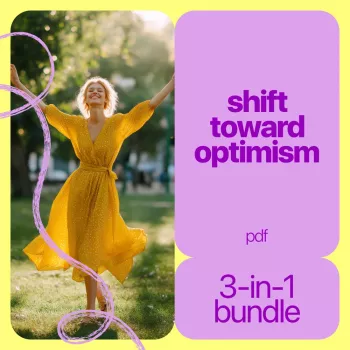
Shift Toward Optimism: Bright Side Up Practices for Everyday Positivity
A practical optimism routine is built from small, repeatable choices: how moments are interpreted, how self-talk is handled, and how attention is guided back to what matters. This guide breaks down a simple, day-by-day approach to thinking more positive without ignoring real challenges, using a structured digital bundle to make the habits easier to follow and repeat.
When life gets busy, it helps to have a lightweight system you can return to—especially during stressful weeks, transitions, or times when motivation drops. That’s where the Shift Toward Optimism 3-in-1 Digital Bundle fits: short lessons, quick prompts, and simple tracking that turns “be more positive” into a doable daily practice.
What “thinking positive” looks like in real life
Optimism isn’t about constant cheerfulness or denying hard realities. It’s a skill: noticing what’s workable, choosing helpful interpretations, and taking the next doable action. Many people naturally have a “threat-bias” (a tendency to scan for what could go wrong), so positivity often means rebalancing with evidence, perspective, and values.
A useful goal is emotional agility: feeling what’s real while steering attention toward constructive choices. Resilience research supports the idea that coping improves when you can acknowledge stress and still move toward purposeful action; the American Psychological Association offers practical guidance on resilience skills and habits (APA: Building your resilience).
What’s included in the Shift Toward Optimism 3-in-1 Digital Bundle
The bundle includes three coordinated digital resources designed to move from intention (“be more positive”) to daily practice (“do this for 5 minutes”). Together, they create a simple framework for reframing thoughts, building optimistic language patterns, and keeping a steady routine you can repeat whenever life feels heavier.
How the 3 parts work together
| Bundle element | Primary focus | Best time to use | What changes over time |
|---|---|---|---|
| Guide / core lessons | Understanding optimistic thinking and how to apply it | First week, then as a refresher | More consistent reframing and fewer “all-or-nothing” conclusions |
| Daily prompts / exercises | Practice in the moment: self-talk, perspective, and gratitude with boundaries | Morning or midday reset | Faster recovery from setbacks and less rumination |
| Reflection / tracking support | Noticing patterns and reinforcing what works | Evening wind-down or weekly review | Clearer triggers, stronger habits, and more intentional choices |
Because it’s designed for repeat use, you can revisit the exercises during crunch-time at work, family changes, health goals, or any season when your mind defaults to pessimistic forecasting.
A simple daily routine for a brighter outlook (10 minutes)
This routine works well with short prompts because it’s structured, quick, and grounded in reality:
- Minute 1–2: Name the current mood and the main stressor in one sentence (this keeps emotions from feeling “everywhere”).
- Minute 3–5: Write one balanced reframe that includes what’s hard plus what’s still possible.
- Minute 6–8: Identify the next smallest helpful action (one email, one walk, one boundary, one question).
- Minute 9–10: Close with one genuine “bright side” note: a resource, person, past win, or lesson—without forcing cheerfulness.
Over time, this reduces the feeling of being stuck in your head. Even a short reset can ease stress by interrupting negative self-talk patterns; Mayo Clinic’s overview highlights how positive thinking can support stress management (Mayo Clinic: Positive thinking).
The mindset shift: from automatic thoughts to chosen interpretations
Automatic thoughts often sound authoritative, but they’re frequently incomplete. Start by catching common thinking traps:
- Catastrophizing (“This will ruin everything.”)
- Mind-reading (“They think I’m incompetent.”)
- Discounting positives (“That doesn’t count.”)
- “Should” statements (“I should never feel like this.”)
Then use a simple three-step reframe:
- What’s the evidence? What facts support the worry, and what facts soften it?
- What’s another explanation? What else could be true that’s less harsh and more realistic?
- What would be most helpful right now? Choose an interpretation that supports a wise next step.
Language matters here. Try “both-and” phrasing: “This is hard, and there are options.” It stays honest while keeping you moving.
Bright Side Up techniques that don’t feel fake
Forced optimism tends to backfire. The goal is grounded positivity—small shifts that feel believable.
If mindfulness helps you notice thoughts without getting pulled into them, brief practices can pair well with reframing. The NIH’s NCCIH overview summarizes evidence and safety considerations for meditation and mindfulness (NCCIH: Meditation and mindfulness).
Staying consistent when motivation disappears
Who this bundle tends to help most
Getting started: a 7-day ramp-up plan
To keep everything in one place, the Shift Toward Optimism 3-in-1 Digital Bundle is designed to support this exact “start small, repeat often” approach.
More in-stock digital bundles to support intentional routines
- The Smart Bundle to Avoid Travel Scams: 3-in-1 Digital Guide, Checklist & AI Tools
- Easy Online Store Setup Bundle: 4-in-1 Guide to Social Store, Google Console, and More
When positivity feels out of reach
FAQ
Does thinking more positive mean ignoring negative emotions?
No. Healthy optimism includes acknowledging pain, uncertainty, and disappointment while choosing balanced reframes, self-compassionate self-talk, and a workable next step without denial.
How long does it take to notice a shift toward optimism?
Small relief can show up in days (less spiraling in the moment), while stronger habits typically build over a few weeks of consistent practice. Useful markers include reduced rumination and quicker recovery after setbacks.
What if the exercises feel forced or cheesy?
Use simpler, more honest language and keep the prompts practical—focus on “what’s true” and “what’s the next step.” Authenticity matters more than upbeat wording, and smaller reps usually feel more natural.
Recommended for you


Large Bowling Shoulder Bag with Sausage Dog Charm
Aug 11, 2026













Leave a comment