-
Shop
- Advanced Technologies
- AI Skills
- AI Skills Mastery 2026 Collection
- Bathroom
- Best-Sellers
- Car Accessories
- Confidence
- Dating & Social Skills
- Digital Resources
- AI & Technology
- Beauty
- Budgeting & Saving
- Car Buying & Ownership
- Electronics & Technology
- Entrepreneurship & Business Growth
- Financial Independence
- Financial Mindset & Psychology
- Goal Setting
- Home Styling & Organization
- Kitchen & Recipes
- Leadership
- Mindset
- Online Business
- Parenting & Child Development
- Personal Style & Fashion
- Pet Lifestyle & Wellness
- Positive Thinking
- Sleep Improvement
- Smart Life with AI
- Stress Management & Relaxation
- Wellness
- Yoga & Mind-Body Practices
- Education & Learning
- Family & Parenting
- Fashion
- Financial Education
- Furniture
- Gadgets
- Health & Beauty
- Health & Wellness
- Home & Garden
- Home Electronics
- Kids & Babies
- Kitchen
- Kitchen Best-Sellers
- Lighting
- Luxury Brands Collection
- Patio, Lawn & Garden
- Personal Growth
- Pet Care
- Pet Supplies
- Pets
- Sport & Outdoors
- Stress Relief & Relaxation
- Travel
- Travel & Adventure
- Wealth
- Popular
- Best deals
1T/2T Hand Chain Hoist: 360° Hook for Shop Lifting
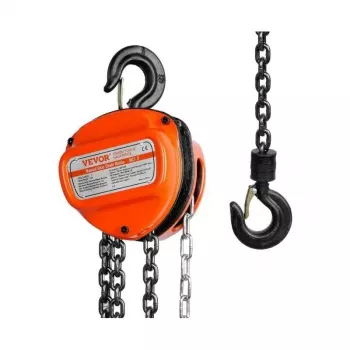
1T/2T Hand Chain Hoist with 360° Rotation Hook for Garage and Factory Lifting
A hand chain hoist is a practical choice when power access is limited or when a job calls for precise, slow, controlled lifting. In a garage, that can mean inching an engine into place without overshooting a mount. On a factory floor, it can mean positioning a fixture or component safely when a powered hoist is unnecessary. This guide explains how a 1T/2T manual chain hoist with a 360° rotating hook fits common workflows, what to confirm before every lift, and how to match capacity and lift height to real tasks. For more guidance, see Elephant Lifting: Hoists, Comealongs, Winches, Beam Crawls.
What this hand chain hoist is designed to handle
Manual chain hoists are built for vertical lifting where control matters more than speed. Typical uses include moving engines, machinery components, steel parts, fixtures, and other shop equipment where the operator needs to “feel” the load and stop exactly where intended. For further reading, see VEVOR Hand Chain Hoist, 1 Ton 2200 lbs Capacity ….
- Controlled lifting and positioning of engines, parts, and equipment during repair or installation
- Common work areas: garages, maintenance bays, small fabrication spaces, warehouses, and light industrial lines
- Useful where electricity or compressed air is unavailable, unreliable, or undesirable for precision/safety reasons
- Best for vertical lifting and positioning when paired with a suitable overhead anchor, trolley, or beam clamp (as applicable)
Because the hoist is only as strong as what it’s attached to, always treat the supporting structure (beam, gantry, trolley, clamp, or lifting point) as part of the lifting system—not an afterthought.
Why a 360° rotating hook helps in tight spaces
Rotating hooks earn their keep when space is limited and you can’t freely walk around the load. Instead of twisting the chain or forcing the sling to “turn” something into alignment, the hook rotation lets you orient the load more naturally.
- Allows the load to be oriented without twisting the chain, reducing binding and improving alignment with the pick point
- Helps when the operator must stand off to the side (around vehicles, pallets, or machine frames)
- Supports cleaner hook engagement and reduces the temptation to side-load the hook while trying to rotate the load
- Speeds up repetitive lifts where the same part must be rotated into a consistent installation position
Rotation improves alignment—but it does not change the basic rule: keep the load centered under the hook and keep the chain running vertical.
Choosing between 1 ton and 2 ton capacity
Capacity selection starts with the heaviest realistic load you expect to lift, then adds the weight of rigging and a practical margin for unknowns. If a component can be stuck, off-balance, or likely to shift slightly as it clears a surface, that “extra” can matter.
- Start with the heaviest real load, including rigging (slings, shackles, spreader bars) and any attached fixtures
- Keep margin for unknowns: stuck parts, dynamic movement, or slight load shift during lift and set-down
- For garage tasks (engine pulls, axle assemblies, shop presses), 1T often covers many jobs; 2T is common for heavier machinery parts and fabrication pieces
- Never exceed the rated capacity; avoid “close enough” estimates when the load weight is not confirmed
| Task example | Approx. load range | Capacity notes |
|---|---|---|
| Small engine / motorcycle engine handling | 200–500 lb (90–225 kg) | 1T typically sufficient with rigging margin |
| Automotive engine + accessories / trans handling | 400–900 lb (180–410 kg) | 1T often works; confirm actual weight |
| Machine components / fabrication assemblies | 800–3,000 lb (360–1,360 kg) | 2T recommended when weight uncertainty is high |
| Palletized parts, dies, fixtures (light industrial) | 1,500–4,000 lb (680–1,815 kg) | 2T with adequate overhead structure; verify pick points |
Key features to evaluate before buying or installing
Two hoists can share the same ton rating but feel very different in day-to-day use. A few build details often determine whether lifting is smooth and predictable or frustrating and jerky.
- Hook design and latch quality: secure latching reduces the chance of a sling eye slipping out during repositioning
- Chain quality and finish: consistent link shape and smooth travel help reduce “chatter” under load
- Brake and load-holding behavior: the hoist should hold steady when the hand chain stops
- Headroom and compactness: important in garages with low ceilings or when lifting inside frames
- Mounting compatibility: overhead beam, gantry, engine support frame, or rated lifting point must support the full system load
Safe lifting setup: what to confirm every time
How to use it for common garage and factory jobs
Engine removal and installation
Machine maintenance and component swaps
Positioning heavy parts at a station
Care, inspection, and storage
Product option available now
- Modern White Vanity Makeup Table Set with Lighted Mirror and Storage
- The Smart Bundle to Avoid Travel Scams: 3-in-1 Digital Guide, Checklist & AI Tools
FAQ
Can a hand chain hoist be used for horizontal pulling?
No. A hand chain hoist is intended for vertical lifting; horizontal pulling can side-load the hook and internal components and may damage the hoist. For pulling, use a come-along or winch designed specifically for that direction of load.
What does a 360° rotating hook change during a lift?
It helps orient the load without twisting the chain, which reduces binding and makes alignment easier. It does not make side-loading acceptable—the load still needs to stay centered under the hook with a vertical chain line.
How often should a manual chain hoist be inspected?
Perform a quick inspection before every use, then schedule more detailed periodic inspections based on how frequently and how heavily the hoist is used. In workplaces, follow your employer’s safety program and applicable standards for documented inspection intervals.
Recommended for you

Two-Room + Hall Tent Guide: Privacy, Space & Comfort
Aug 14, 2026
Multi-Pet Hygiene Routine: Fresh Home, Less Odor
Aug 14, 2026













Leave a comment